

Millions of Americans are living with missing teeth, and the gap between how common that problem is and how often people do something about it is wider than most people realize. Tooth loss affects daily life in real, tangible ways, from how you chew and speak to how confident you feel walking into a room. The research on this topic is compelling, and the statistics paint a clear picture of why dental implants have become one of the most widely pursued restorative options in modern dentistry.
At Dental Associates of Jersey City, our team has seen firsthand how dental implant placement changes the way patients engage with the world around them. Dr. Andriy Yuzvyak, who completed his DDS at Touro College of Dental Medicine and received the Harold Litvak Award through his specialty training at NYU College of Dentistry’s Jonathan and Maxine Ferencz Advanced Education Program in Prosthodontics, leads a team well-versed in the full scope of implant care. Everyone on our team is trained to perform implants, and we take a comprehensive approach to every case.
How Many Americans Are Affected by Tooth Loss
The scale of tooth loss in the United States is significant. According to the National Institute of Dental and Craniofacial Research, adults between the ages of 20 and 64 are affected by tooth loss at rates that climb considerably with age, income level, and smoking status. Older adults, current smokers, and those with lower incomes are disproportionately impacted. These numbers make clear why restorative dentistry is not a luxury for most patients; it is a real health need.
The NIDCR’s 2022 Oral Health in America bulletin also notes that while overall rates of complete tooth loss have declined, the ongoing challenge is ensuring that people who do experience tooth loss have access to effective, long-lasting solutions. Dental implants have become a central part of that picture, particularly as more adults retain their natural teeth longer and require restorative support when individual teeth are lost.
The Global Growth of Dental Implants
Dental implants have grown from a niche procedure to one of the most widely accepted treatments in dentistry. According to a 2025 review published in PMC, the global dental implant market is projected to reach USD 16 billion by 2029, growing at approximately 7.5% per year. A separate analysis estimated that around 12 to 15 million dental implants are placed annually worldwide, a figure reflecting just how mainstream the treatment has become.
Research also projects that the prevalence of dental implants in the United States alone could reach 23% by 2026. That growth is being driven by a combination of improved materials, better surgical techniques, and greater public awareness of implants as a durable alternative to bridges and dentures.
What the Research Says About Implant Success Rates
One of the most frequently cited benefits of dental implants is their long-term reliability, and the data support this. A 2024 meta-analysis published in PMC examining 20-year dental implant survival rates found that survival rates consistently exceed 90% even after a decade of function. Multiple systematic reviews and high-quality analyses across diverse patient populations have substantiated these findings.
For patients with certain health conditions, the outcomes remain encouraging when managed carefully. A 2024 systematic review found that in patients with well-controlled type 2 diabetes, implant survival rates ranged from 96.1% to 97.3% at one year. This highlights the importance of coordination between your dental team and your broader health providers when planning treatment.
What Factors Influence Long-Term Success?
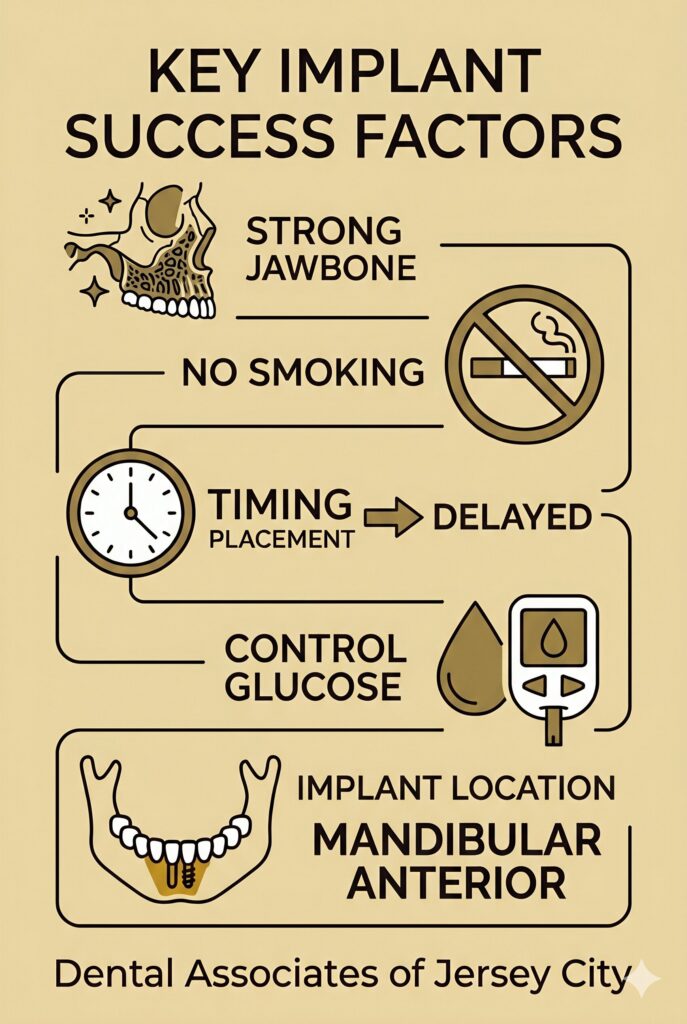
Success rates are not identical across every patient or every case. Research has consistently identified several variables as significant predictors of implant outcomes. The following are among the most studied:
- Bone quality: Cases involving adequate bone density tend to show higher long-term survival rates, which is why bone grafting is often considered part of a comprehensive implant plan.
- Smoking status: Smoking has been identified as a meaningful risk factor for early implant failure across multiple studies.
- Placement timing: A large-scale study of over 158,000 implants found that delayed placement was associated with lower failure rates than immediate placement.
Each of these factors reinforces why a thorough evaluation before treatment is so important. A well-planned bone grafting procedure ahead of implant placement, for instance, can meaningfully improve long-term outcomes for patients who need additional bone support.
Why Implants Stand Apart from Other Restorative Options
Among the available options for replacing missing teeth, implants offer something bridges and dentures cannot: preservation of the underlying bone. When a tooth is lost, the jawbone in that area begins to deteriorate over time. Implants, by integrating directly with the bone, help maintain bone structure and prevent the gradual changes in facial appearance associated with prolonged tooth loss.
Our approach at Dental Associates of Jersey City incorporates digital dentistry tools and fully guided implant placement protocols. Dr. Yuzvyak has developed his own protocol for full-arch rehabilitation, and our prosthodontics team is trained to handle both limited- and comprehensive-case scenarios. Whether you need a single tooth replaced or a full arch restored, we treat each case with the same level of care and clinical precision.
A Stronger Smile Is Within Reach at Dental Associates of Jersey City
If you have been living with a missing tooth or are considering your options for full mouth reconstruction, the statistics make a compelling argument for acting sooner rather than later. Bone loss, changes in bite alignment, and effects on adjacent teeth all tend to progress the longer a gap goes unaddressed. Our team at Dental Associates of Jersey City brings advanced training, a complete suite of implant services, and a commitment to staying at the forefront of implant techniques to every patient consultation.
We proudly meet and surpass all OSHA and CDC standards, and we are members of the ADA and Maxwell Facial Societies. From initial evaluation through final restoration, we are here to walk you through every step of the process. Contact our office to schedule your consultation and take the first step toward a complete, healthy smile.